
People often search for frozen shoulder treatment in Kolkata when one shoulder movement suddenly becomes difficult: reaching behind the back. The arm may lift forward, but fastening clothes, reaching a back pocket, tucking in a shirt, or sleeping on one side becomes painful or blocked.
Why can lifting the arm feel possible, but reaching behind the back feels impossible?
Reaching behind the back needs a specific combination of shoulder movements, especially internal rotation and extension. When the shoulder capsule becomes tight, tendons become painful, or the joint surface is irritated, this movement can become restricted even when lifting the arm forward is still possible.
Watch these daily movement clues:
| Daily problem | What it may suggest |
|---|---|
| Cannot fasten blouse, bra, kurta hook, or shirt behind the back | Restricted shoulder rotation |
| Cannot reach a back pocket | Posterior shoulder stiffness or capsular tightness |
| Can lift the arm forward but cannot rotate it backward | Movement-specific restriction |
| Pain while sleeping on one side | Frozen shoulder or rotator cuff irritation |
| Pain with weakness while lifting | Rotator cuff involvement may need assessment |
| Stiffness with grinding or age-related pain | Arthritis may need to be ruled out |
For patients who can lift the arm but struggle with fastening clothes, reaching a back pocket, sleep pain, or long-standing stiffness, a structured evaluation for shoulder stiffness and movement loss can help clarify whether the pattern fits frozen shoulder, rotator cuff pain, or another shoulder condition.
The confusing part: “I can raise my arm, so why is this movement blocked?”
This is the part that frustrates many patients.
They can lift the arm to comb hair. They may even reach a shelf. But the moment they try to tuck in a shirt, reach a wallet, wear a blouse, scratch the upper back, or fasten innerwear, the shoulder stops.
Sometimes it feels like pain. Sometimes it feels like a tight wall.
Many patients do not notice the stiffness during big movements first; they notice it during private daily tasks like dressing, bathing, or reaching behind the body. Some quietly change habits. They wear front-open clothes. They stop sleeping on one side. They ask for help while dressing. They avoid the movement because it hurts.
That is not always a simple weakness.
The shoulder has several directions of movement. Losing one direction early can still disturb daily life before the whole shoulder feels “frozen.”
Which shoulder movements are usually affected first?
Rotation is often one of the early movements patients notice losing.
The shoulder is not a simple hinge. It depends on the ball-and-socket joint, capsule, tendons, muscles, and shoulder blade moving together. When the capsule tightens or the shoulder becomes painful, combined movements become difficult.
Movements that may become restricted include:
- reaching behind the back
- rotating the arm outward
- reaching across the chest
- placing the hand behind the head
- lifting the arm comfortably
- sleeping on the painful side
AAOS describes frozen shoulder, also called adhesive capsulitis, as a condition that causes shoulder pain and stiffness and often progresses through painful and stiff phases. Its patient guide on frozen shoulder also explains that physical therapy focused on shoulder flexibility is commonly used in treatment planning.
A useful clinical clue is passive movement. If another person gently tries to move the shoulder and it still does not move freely, the stiffness may be coming from the joint capsule rather than only muscle weakness.
Is it a frozen shoulder or a rotator cuff problem?
Frozen shoulder usually limits both active and assisted movement. A rotator cuff problem more often causes pain, weakness, and difficulty lifting or rotating the arm against resistance.
That difference matters.
In a frozen shoulder, the shoulder feels blocked. The patient cannot move it fully, and the examiner may also find reduced motion during assisted movement.
In rotator cuff pain, movement may be painful and weak, but the shoulder may still move better when assisted. A patient may struggle with overhead activity, lifting, combing hair, or reaching backward because the tendon is irritated or injured.
Mayo Clinic notes that rotator cuff injury can cause a dull ache that worsens at night and may make it difficult to comb hair or reach behind the back. Its patient resource on rotator cuff injury symptoms gives a clear overview.
The two problems can overlap. A painful shoulder may become stiff because the patient avoids movement. A stiff shoulder may also irritate surrounding tendons. That is why guessing from one symptom alone is risky.
Frozen shoulder vs rotator cuff pain vs arthritis movement pattern
| Feature | Frozen shoulder | Rotator cuff pain | Shoulder arthritis |
|---|---|---|---|
| Main complaint | Stiffness with pain | Pain with weakness | Pain, stiffness, grinding |
| Behind-the-back reach | Often very restricted | Painful, sometimes weak | Painful and stiff |
| Assisted movement | Also restricted | May be better than active movement | Restricted depending on joint damage |
| Night pain | Common in painful phase | Common in tendon irritation or tear | Can occur in advanced disease |
| Strength | Limited by pain and stiffness | True weakness may be present | Reduced due to pain and stiffness |
| Imaging need | Often to rule out other causes | Ultrasound or MRI may be considered | X-ray may be useful |
| Common clue | Shoulder feels blocked | Shoulder feels painful or weak during lifting | Pain with crepitus or age-related stiffness |
The table cannot replace an examination, but it can help patients understand why the same shoulder complaint may need different treatment planning.
When are X-ray, ultrasound, or MRI considered?
Imaging is considered when the diagnosis is unclear, pain follows an injury, weakness is present, arthritis is suspected, symptoms are severe, or the shoulder is not improving as expected.
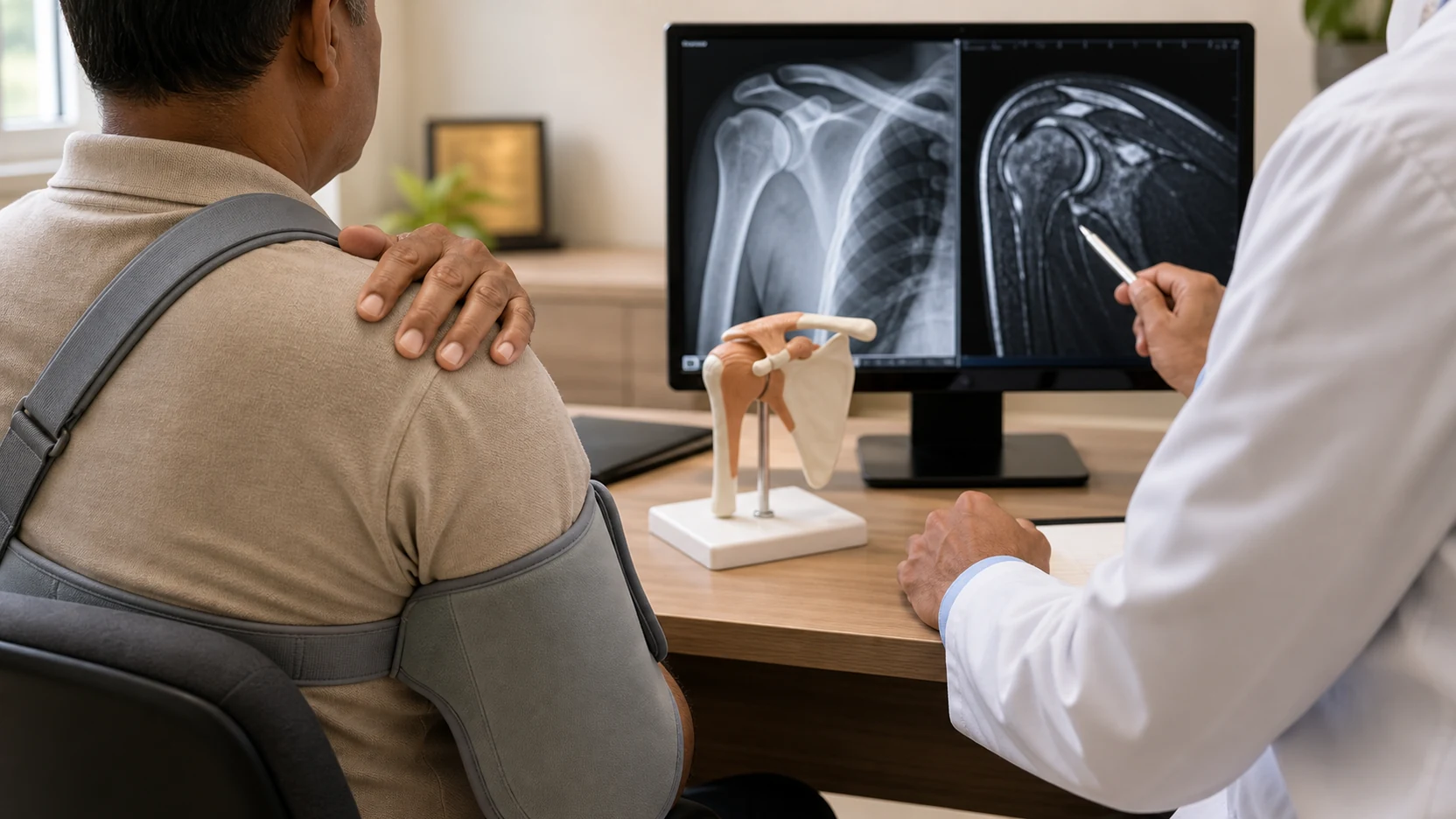
An X-ray may be advised to check arthritis, joint-space narrowing, old injury, calcium deposits, or bone-related causes of stiffness. Frozen shoulder itself may not always show clearly on X-ray, but the test can help rule out other problems.
Ultrasound may be useful when rotator cuff tendon irritation or tear is suspected. MRI may be considered when there is significant weakness, traumatic injury, persistent night pain, suspected tendon tear, or uncertainty after clinical examination.
The test should answer a clinical question. Imaging should not replace a careful movement assessment.
When should you see a shoulder stiffness doctor in Kolkata?
Patients should see a shoulder stiffness doctor Kolkata when reaching behind the back, fastening clothes, sleeping on one side, or rotating the arm becomes difficult for more than a short painful phase. Difficulty reaching behind back is especially important when it affects dressing, personal care, sleep, or work, because it may show that the shoulder is losing rotation rather than only strength.
The consultation should check whether the movement loss fits frozen shoulder, rotator cuff pain, arthritis, post-injury stiffness, or another shoulder condition.
Patients should not wait too long when:
- stiffness is increasing week by week
- sleep is repeatedly disturbed
- diabetes is present
- the hand cannot reach behind the back
- pain remains after basic care
- weakness appears while lifting
- movement is not returning after physiotherapy
- symptoms follow injury or surgery
The aim is not to force the shoulder aggressively. The aim is to understand the stage, reduce pain safely, and restore movement gradually.
When does frozen shoulder treatment in Kolkata become necessary?
Frozen shoulder treatment in Kolkata becomes necessary when stiffness starts interfering with dressing, sleep, bathing, work, driving, or daily independence.
Treatment planning may include pain control, guided physiotherapy, home exercises, activity modification, diabetes control where relevant, injections in selected cases, and further evaluation if stiffness does not improve.
A frozen shoulder specialist Kolkata should look beyond one movement and assess the whole pattern: how the stiffness started, which direction became difficult first, whether sleep is affected, whether diabetes or thyroid disease is present, and whether pain or weakness suggests another condition.
Why diabetes changes the conversation
People with diabetes are more prone to frozen shoulder, and stiffness may last longer or behave more stubbornly in some patients. This does not mean every diabetic patient with shoulder pain has frozen shoulder, but it should raise attention when movement keeps reducing.
The pattern is often familiar. Shoulder pain appears first. Sleep becomes difficult. Reaching behind the back becomes limited. Later, more directions of movement become restricted.
For diabetic patients, shoulder stiffness should not be ignored as normal ageing. Early assessment can help set realistic expectations for pain control, physiotherapy, and recovery time.
What patients should expect during evaluation
A good shoulder evaluation should not feel rushed.
The doctor may ask when stiffness started, which movement failed first, whether there was an injury, whether sleep is disturbed, whether diabetes or thyroid disease is present, and whether previous physiotherapy helped.
During examination, the shoulder is usually checked in different directions: forward elevation, side lifting, external rotation, internal rotation, behind-the-back reach, cross-body movement, and strength testing. This helps separate stiffness-dominant problems from weakness-dominant problems.
Patients should carry previous X-rays, ultrasound, MRI reports if available, diabetes records, prescriptions, and a simple note of daily movements that are difficult.
Dr. Manoj Kumar Khemani may be relevant for patients who need orthopedic evaluation for shoulder stiffness, restricted rotation, night pain, and suspected frozen shoulder. The Heal My Bones website can help patients understand when persistent shoulder stiffness needs clinical review instead of repeated self-care.
FAQ
Why does frozen shoulder pain get worse at night?
Frozen shoulder pain can worsen at night because the inflamed and stiff shoulder capsule becomes painful when the arm rests in certain positions. Night pain is more concerning when it repeatedly disturbs sleep or is linked with increasing stiffness. Patients should avoid sleeping directly on the painful side and seek evaluation if sleep pain continues.
Does diabetes increase the risk of frozen shoulder?
Diabetes can increase the risk of frozen shoulder and may make stiffness more persistent in some patients. Blood sugar status does not diagnose the shoulder problem, but it can influence recovery planning and treatment expectations. Patients with diabetes and increasing shoulder stiffness should discuss both shoulder movement and diabetes control with their doctor.
How long does shoulder stiffness from frozen shoulder last?
Frozen shoulder stiffness can last months and sometimes longer, depending on the stage, severity, diabetes status, treatment timing, and physiotherapy consistency. Recovery is usually gradual rather than sudden, and forceful stretching during severe pain can irritate the shoulder. A doctor can help decide whether stiffness is progressing as expected or needs a change in treatment plan.
Can physiotherapy help if I cannot reach behind my back?
Physiotherapy can help many patients with restricted behind-the-back movement when exercises are matched to the stage of pain and stiffness. The approach may include gentle stretching, mobility work, posture correction, strengthening, and home exercises, but aggressive stretching during severe pain may not be suitable. Patients should get assessed if movement is worsening despite exercises.
Practical next step
If you can lift your arm but cannot reach behind your back, do not dismiss it as simple weakness. That one blocked movement may be an early clue that the shoulder capsule, tendons, or joint surface needs proper evaluation.
The safer next step is to note which movements are blocked, avoid forceful stretching, and get the shoulder assessed if stiffness keeps increasing.
Medical Disclaimer
This article is for general educational purposes only and should not be taken as personal medical advice, diagnosis, or treatment recommendation. Shoulder stiffness, frozen shoulder, rotator cuff pain, arthritis, imaging needs, physiotherapy suitability, injections, recovery time, and treatment choices vary from patient to patient. Please consult a qualified orthopedic doctor with your symptoms, reports, medical history, current medicines, and physical examination findings before making any treatment decision.